

Hobby Deep Dive: Miniatures
The small contains multitudes
I’m so grateful that I discovered my new hobby of miniature making—not only because I love being a miniaturist, but also because, as a curious designer and researcher fascinated by human behavior, I’ve realized the world of minis is appropriately described as multum in parvo (a Latin phrase meaning “much in little” or “the small contains multitudes”).
The big history of miniatures
I started making minis almost two years ago. Since then, I’ve spoken with numerous miniaturists, read books and articles, and even enrolled in an art history course on miniatures through the Barnes Foundation. I’ve learned that humans have been creating miniatures across cultures for millennia. My instructor, Julie Steiner (an art historian and miniaturist who knits unbelievably tiny sweaters) blew my mind when she observed that “in nature, there are no miniatures”—only small things. Minis are a uniquely human creation, a cultural phenomenon rooted in our drive to replicate life at a smaller scale.
Some minis have practical applications in fields like architecture, film production, curation, and prototyping. Models allow makers to visualize concepts, gain buy-in, and test hypotheses before going full scale. These small versions often serve as instructions for how to build or replicate the real thing.
Take, for example, this diorama of a granary, made over 4,000 years ago. It was sealed in a hidden chamber in an Egyptian tomb, perfectly preserving the 29½ by 22-inch structure and protecting it from early tomb raiders. Historians believe it was created to provide instructions for daily life in the afterlife.
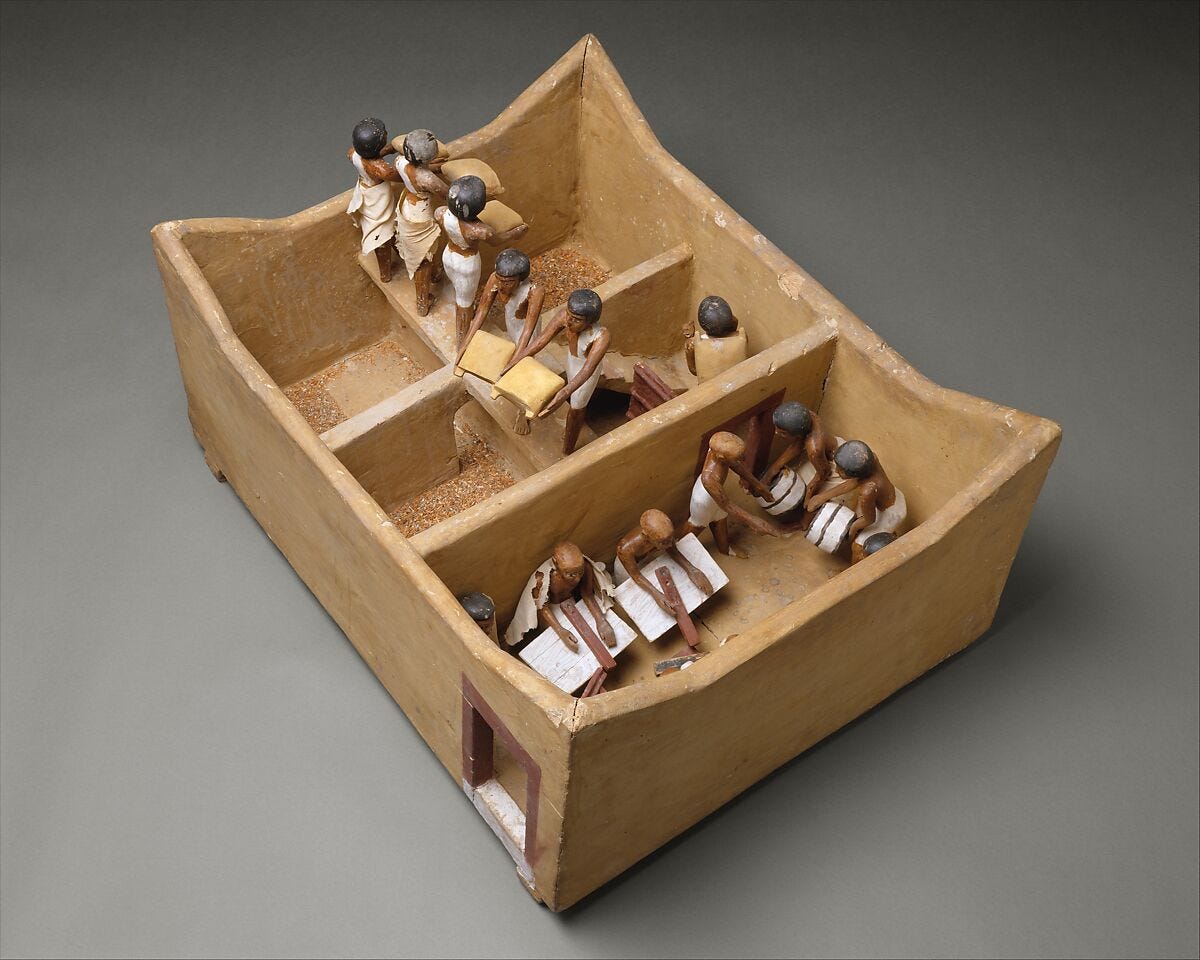
Ancient architectural models like these help historians understand details about past cultures that have since eroded over time. As Julie pointed out in our class, it’s hard to preserve an entire room or building for centuries (and most museums don’t have the space to exhibit them), but a miniature can serve as an enduring, compact artifact.
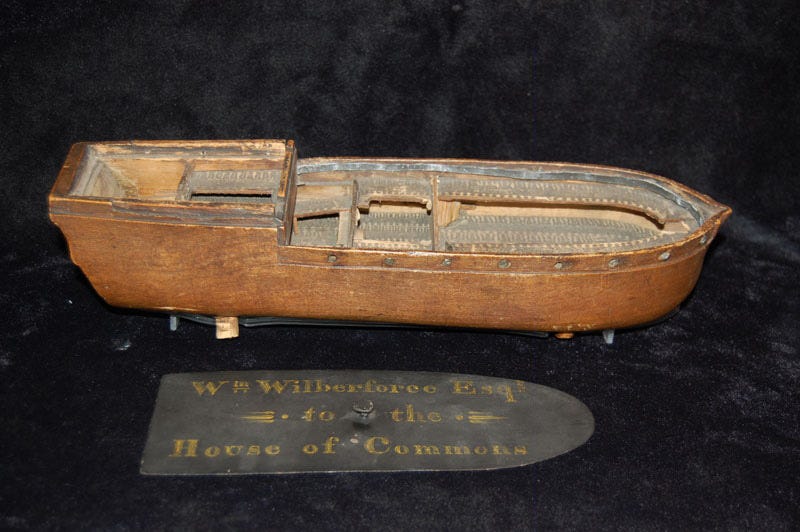
Miniatures can also create empathy. Their small scale forces us to lean in and see something in its entirety, which can help deepen understanding. A powerful example is the below model of a slave ship that circulated through British Parliament in the 1780s. It made the inhumanity of the slave trade both visible and visceral. This miniature is believed to have directly influenced the end of Britain’s participation in the slave trade. (I learned about it in the fascinating book In Miniature by Simon Garfield, which is worth the read even if you aren’t a miniaturist.)
There are countless examples of minis in art and culture across the centuries human existence, serving many different purposes and telling many stories. I’m tempted to list more, but I know I can’t do them justice in a single post. The tl;dr is this: the history of miniatures is vast, cross-cultural, and deeply human. The small contain multitudes, after all.
Today’s hobby miniaturists
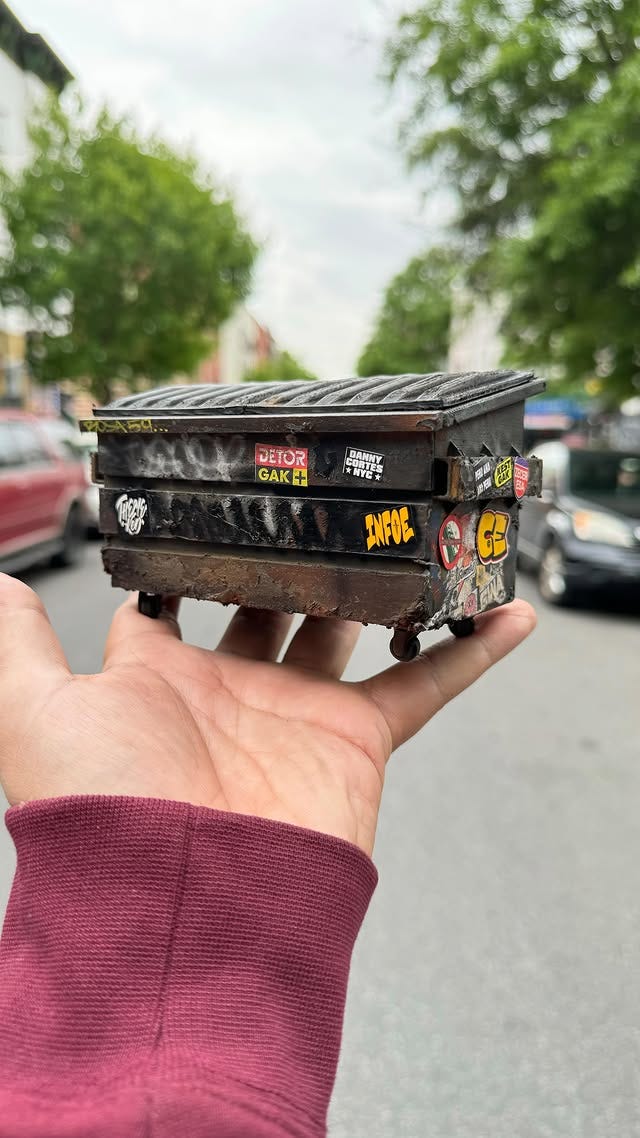
As oxymoronic as it sounds, the world of hobby miniaturists is actually quite large if you consider all hobbies that involve shrinking something down. I’m partial to dollhouse miniatures, which focus on interiors, but there are also makers who create dollhouse-style exteriors: tagged-up doors, storefronts, dumpsters—meticulously replicated at scale with "grimy" dirt and rust applied using weathering powders and eyeshadow applicators.
Mini means of transportation, like model planes, ships, and cars, are another way hobbyists shrink the world. Model trains bridge the transportation and dollhouse subgenres, with elaborate towns and scenery. I’ve picked up dollhouse-friendly tips from train hobbyist tutorials on YouTube.
Today’s miniaturists tend to fall into one or more of these categories:
Collectors – purchase pre-made miniatures to display, arrange, or play with in miniature scenes.
Kit Builders and Painters – assemble pre-made kits or paint pre-made objects.
Scratch Builders/Kit Creators – design and build their own miniatures, sometimes creating kits or tutorials for others.
These categories aren’t mutually exclusive, and many hobbyists straddle multiple roles. At Practice, we’re most focused on supporting Kit Builders and Scratch Builders, since their hobbies involve focused handwork and craft.
Miniature motivation
In my miniatures art history course, instructor Julie Steiner discussed the wide range of motivations that have compelled people to create miniatures throughout history. These include:
Capturing a moment in time
Demonstrating skill by making something exceptionally small
Creating souvenirs or portable versions of large things
Preserving craft methods
Showcasing wealth and worldliness
Articulating identity
Making big ideas personal and more 'knowable'
Pure delight and whimsy
Some (haters) believe hobby miniaturists are driven by a desire for control or fantasy, since the small scale allows them to create a world that may be unattainable in real life.
For me, the appeal of miniatures is the joy, peace, and meaning I get from the process. I love that I get to apply multiple craft techniques to a single project and create something that bends reality. I like making scenes that look life-sized in photos—until a giant set of fingers enters the frame.
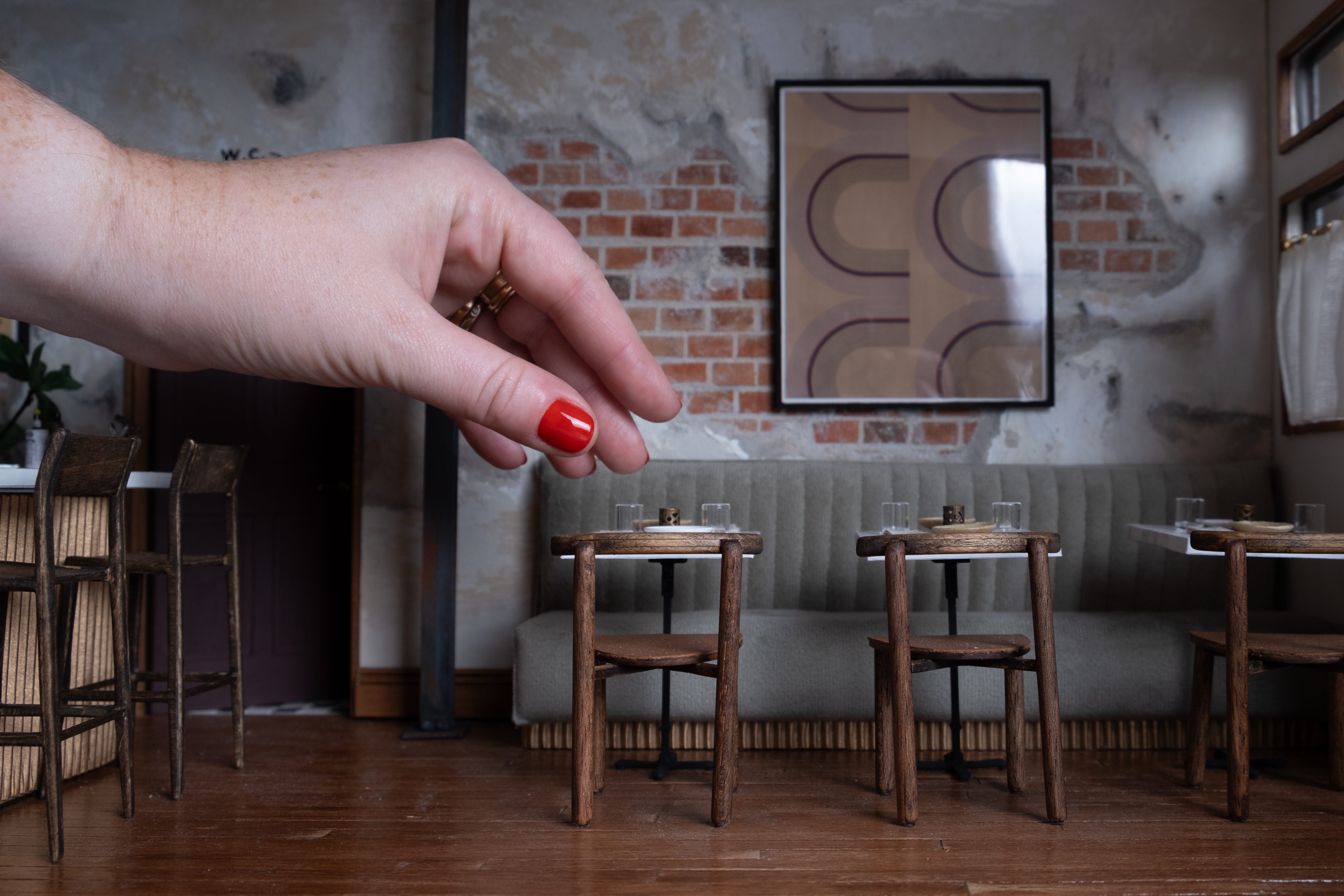
And because I’ve practiced this hobby regularly for nearly 2 years I can see my personal growth and progress. My skills have improved, and I’m a much better maker than when I started. It’s incredibly satisfying to see how my craft has evolved—far more rewarding than reflecting on other "hobbies" I’ve had (like reviewing the list of shows I’ve watched on Netflix).
The hobby has also changed the way I see the world. I now notice the mundane details of interior spaces—like where light switches are placed or how a bar is organized. I deconstruct objects into their component shapes: flat planes, spheres, tubes, and rods. I walk the aisles of hardware and craft stores wondering how I might repurpose objects into miniatures. Chair leg protectors make perfect miniature pots for plants, beads become ornaments, and a screen patch can look like caning on a chair back.
Just this morning, I rinsed the cap from an empty tube of toothpaste and tossed it in my "Bits and Bobs" bin because I know it may come in handy for a mini scene one day.
My hobby has made me more observant, present, and grateful as I navigate the world.
Miniatures and Practice
Regardless of their purpose or the motivations of their makers, miniatures have played a rich role in human history and culture. And, yes, I’m biased—but I think they’re an incredibly fulfilling and fun hobby.
With Practice, we can’t wait to introduce more people to the world of miniatures—if it’s right for them. Our Hobby Match feature will help people discover if it’s a good fit for their skills, interests, and preferences. And if it is, we’ll support them in building their practice as they create mini worlds and scenes of their own.
The best part? There are dozens of other creative hobbies with equally deep histories and powerful benefits. So if miniatures aren’t a good fit, that’s okay, there are so many other hobbies to explore! Our goal is to help people discover the one that’s right for them, so they can experience the joy of making and grow in their creative practice.
For me, it’s minis. What will it be for you?
Hi Erica!
This reminds me of an exhibit I once saw at the Disney Family Museum in SF. Walt was utterly fascinated with miniatures and minature-craft. Miniatures thus became a critical element in the development of the Disneyland concept.
Ref:
https://www.waltdisney.org/blog/miniature-worlds-walt
Erik Ehrke