

Defining a "Practice Hobby"
The criteria shaping our initial hobby shortlist
Quick disclaimer: Last week, I talked about issues with the word “hobby,” but I’m going to use it a lot here. Sometimes you have to work through things in parallel. I apologize for the incongruity, but welcome to the beautifully messy process of starting a company.
Ben and I had my dream meeting last week. It was super productive—we tackled important topics, made decisions, and determined next steps—and yes, we also crafted.
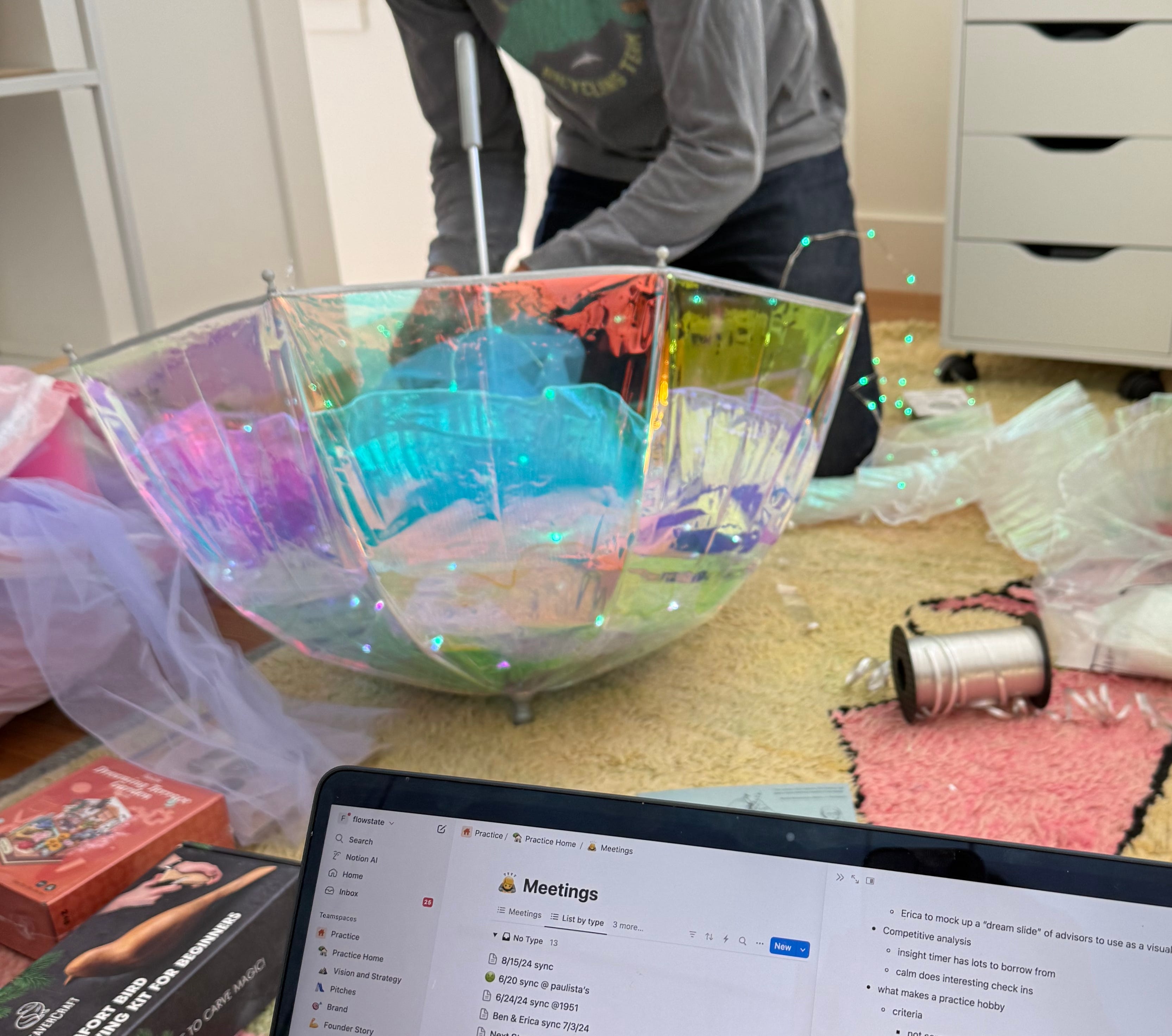
As Ben put together an amazing jellyfish Halloween costume for his daughter, we nailed down our definition of what is—and isn’t—a “Practice Hobby.”
Whittling down (🥁) our hobby list
There are so many hobbies out there. While we don’t want to limit ourselves in the long run, we’re creating a focused, intentional set for our initial launch of Practice for a few reasons:
Practice’s “Hobby DNA” includes several attributes associated with each hobby. Populating those is no small task—and still somewhat experimental.
We want to start with activities that have the highest potential to boost well-being, so we can create joy and positive impact from day one.
Ben and I each had a slightly different list of “Practice Hobbies” in mind, based on our own unspoken criteria.
So we decided to convert our ideas from separate, personal brain soup to an official, shared set of criteria. That way we could create an initial list of hobbies, non-arbitrarily.
Crafting our criteria
Much of the research on the benefits of creative hobbies is about “focused handwork”: using your hands to make something. It’s no coincidence that hands are a big part of Practice’s branding and that “focused handwork” is at the top of our list of criteria for any Practice Hobby. That being said, hand use and mobility varies for everyone, which is why “piece/part size” and “level of fine motor skills required” are attributes we’re capturing in our Hobby DNA. We welcome all people to join us on Practice and are eager to help folks adapt activities to fit their unique needs!
Back to our criteria. We want to maximize the potential for Flow, which means matching users to the right mix of skill and challenge. To do this, we’re avoiding hobbies with high barriers to entry, whether that’s excessive training, specialized skills, or exorbitantly pricey materials. Flow is more attainable with activities that have clear goals and provide a sense of progress, so we’re excluding more conceptual activities and those that take years to complete (looking at you, Bonsai). We also want activities that create something tangible you can display, gift, or experience over time. Cooking, jam making, gardening, and other perishable or seasonal hobbies are, of course, enriching, but their ephemerality means they’re off the list—for now.
To support Flow, you also have to minimize distractions, so we want hobbies that require minimal screen time, especially since screen addiction and doomscrolling contribute to the stress and burnout we see today.
Finally, we have some hypotheses about what helps build enduring habits—like reducing the pressure to make “Art with a capital A”, the ability to personalize and control the output, and avoiding pure “skill tests”—which we’ll test and explore as we launch.
Oh, and of course: Practice is all about helping people create joy from a creative hobby, so joy potential is very important.
Our official list of criteria
So, given all of that, a “Practice Hobby”…
🤏 Requires focused handwork
🪨 Results in something physical—a tangible artifact that has some utility or aesthetic value
🛗 Is accessible
⚖️ it has a relatively low barrier to entry in terms of challenge level/skill floor
⏳ Once ”onboarded”, it’s something you can do whenever you have the time and desire
🎨 It doesn’t require formal art training or highly specialized materials
🤗 People of nearly all ages and abilities can participate
🧑🎨 Is not traditional fine art (e.g. oil painting, sculpture) and isn’t intended to be “Art with a capital A“
📵 Is not screen-based and can be done without one
❄️ Allows the hobbyist to personalize the output and control the outcome, even if following a pattern or kit
🧩 Isn’t solely a “skill test”, though may involve problem-solving
✨ Has the potential to create joy
Criteria in action
So, what meets the criteria and is a Practice Hobby?
The list is still evolving, but for now, these are the initial hobbies on our list that meet all of our criteria:
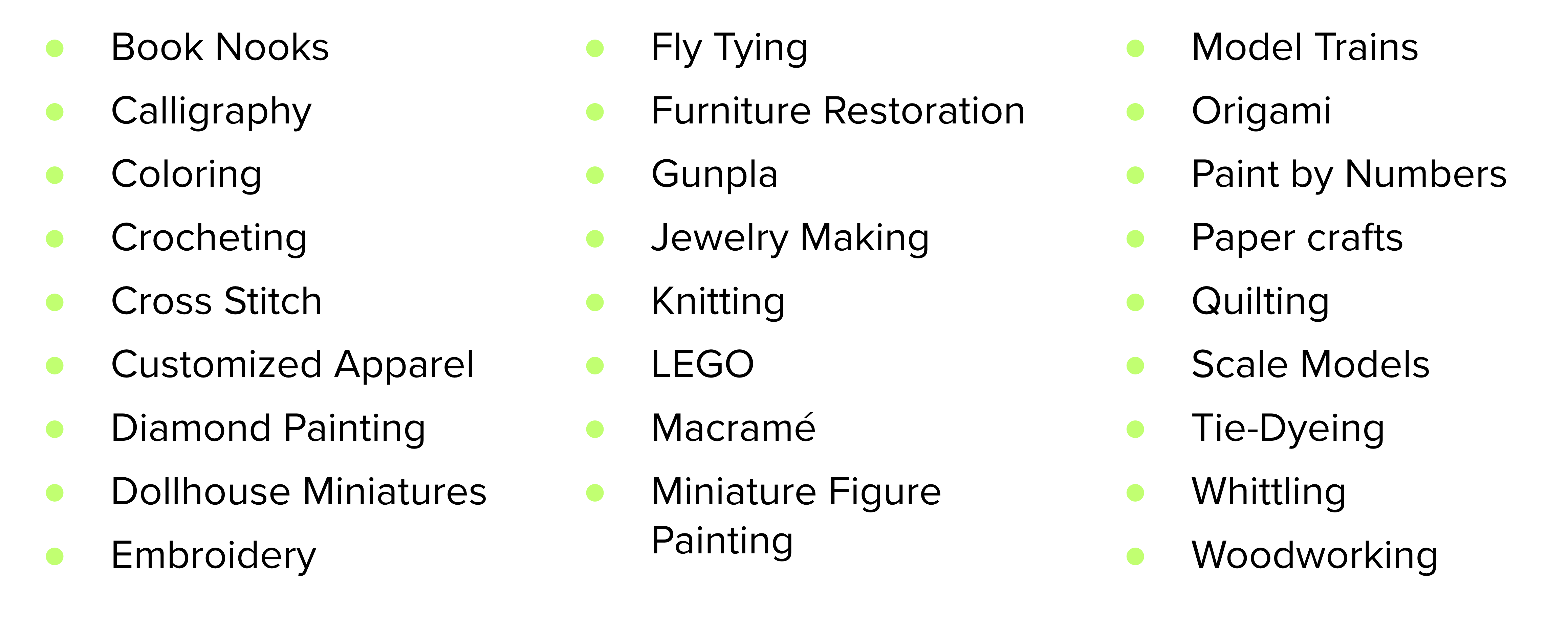
This is no guarantee that the list will stay static. In fact, I had to replace this screenshot 3 times over the course of the 2 days I worked on this post.
Examples of hobbies that don’t meet our criteria
We don’t want to be the hobby police or yuck anyone’s yum, but here are some (potentially surprising) hobbies that aren’t on our initial Practice Hobby list:
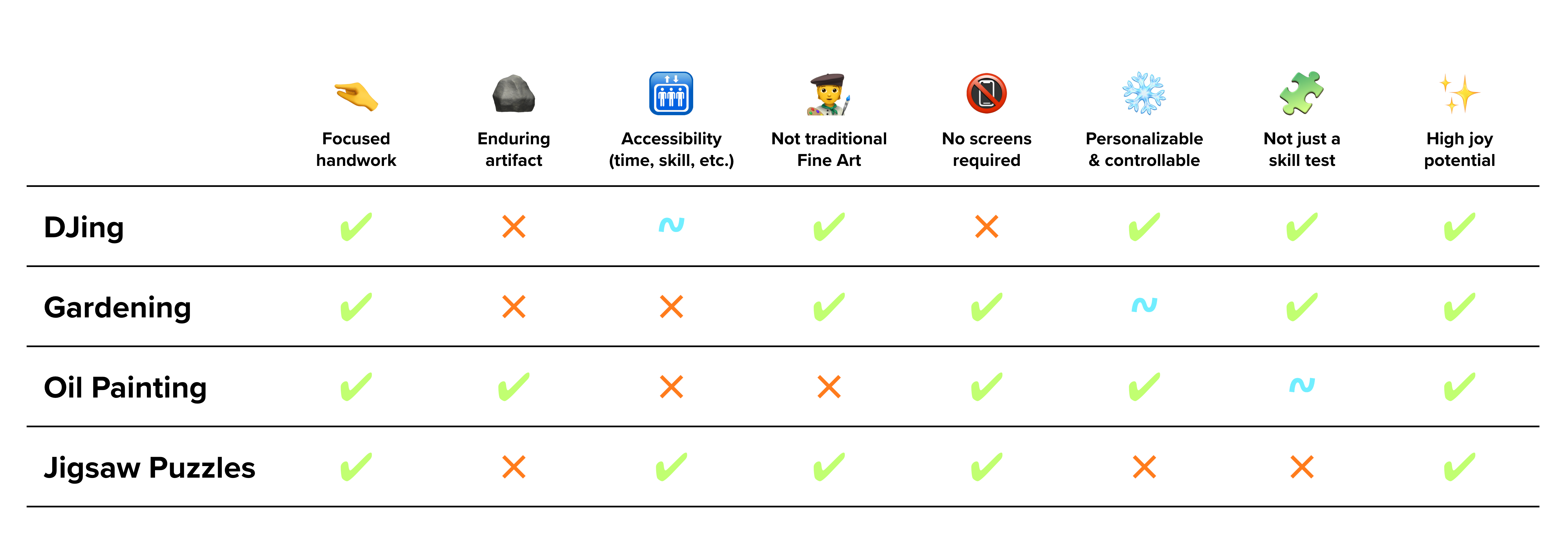
DJing is NOT a Practice Hobby because while it requires focused handwork, it doesn’t create a tangible artifact. Plus, depending on your setup, it’s likely screen-based. My husband has gotten into DJing recently, and he is definitely annoyed that it didn’t make the cut.
Gardening is NOT a Practice Hobby. While it involves focused handwork, the outcome is often beyond the hobbyist’s control as plants grow, change, and sometimes die. Gardening is seasonal and requires daylight, so it isn’t something you can do anytime.
Oil painting is NOT a Practice Hobby because it has a huge skill floor. It often requires formal art training and specialized, somewhat toxic, materials. It is also associated with fine art.
Jigsaw puzzles are NOT a Practice Hobby because they don’t create a lasting, tangible artifact (though we see you and appreciate you, folks who Mod Podge your puzzles and frame them). Puzzles are primarily skill tests and pattern matching—a wonderfully immersive pastime, but not a Practice Hobby given our current criteria.
But seriously, all hobbies are great!
It feels strange to exclude some of these hobbies, and even with our criteria, it feels a little arbitrary and exclusionary. But having a rubric helps us make consistent decisions and stay aligned, and feels more intentional than just picking 30 random hobbies.
At the end of the day, we want people to make time for making in their lives, so we’re excited if you find any way to do that. We won’t prevent Practice users from tracking whatever hobby they choose. And we’ll use that user input to add hobbies as we go. But in the short term we won’t officially recommend or support hobbies that don’t meet our criteria. But these criteria may adjust, and we may add more hobbies in the future. In fact, both probably will happen.
Is your hobby excluded, and are you mad about it? Is something missing from our list? Let me know in the comments or at erica@practicemaking.com